
World Gym Corporation (2762 TT): From Domestic Leader to Global Platform: Early Signals of a Structural Re-rating
Company Overview
Founded in 1976 in California, World Gym Corporation has evolved into a globally recognized fitness brand and is now the leading fitness chain operator in Taiwan. Following its acquisition of World Gym International, the company assumed global brand ownership and franchising rights, expanding its role beyond domestic gym operations. Its business model combines recurring membership revenue with service-driven offerings such as personal training, supported by a growing ecosystem of digital and wellness initiatives. With an expanding international footprint, World Gym is increasingly positioned as an integrated fitness and lifestyle platform.
Key Points
A dominant domestic platform with deepening monetization: World Gym has established a leading position in Taiwan’s fitness market, supported by a network of over 140 locations and a member base approaching 500,000 users. Beyond scale, the operating model is increasingly driven by engagement and monetization rather than simple member growth. Approximately 180,000 members participate in personal training, implying penetration of ~35–40%, with service revenue forming a key earnings driver. With Taiwan’s fitness penetration still below 5%, the company continues to benefit from both network expansion and same-store sales growth, supporting a gradual shift toward a more productivity-driven and monetization-focused model.
Global expansion is supported by a scalable franchise platform: Following the acquisition of World Gym International, World Gym has expanded beyond a domestic operator into a global brand owner with franchising capabilities. The company now oversees 280+ clubs across more than 10 countries, providing a foundation for international growth. Management has indicated plans to add approximately 40–50 global units in 2026, building on recent expansion momentum. Initial efforts are focused on Southeast Asia, where fitness penetration remains low (e.g., Thailand ~3%). The combination of direct expansion and franchising introduces a scalable growth pathway, although execution and localization will be key to long-term success.
Product innovation is enhancing engagement and revenue per user: The company is expanding its monetization model through new products and services aimed at increasing average revenue per user and strengthening customer retention. Pilates programs, implemented through a “club-within-a-club” model, enable incremental revenue generation while leveraging existing infrastructure. In parallel, the company is developing its “Gym 2.0” platform, integrating 50+ biometric indicators, nutrition tracking, and AI-driven coaching. These initiatives reflect a shift toward a more holistic health and wellness offering. While still early in monetization, they have the potential to deepen customer engagement and support higher lifetime value over time.
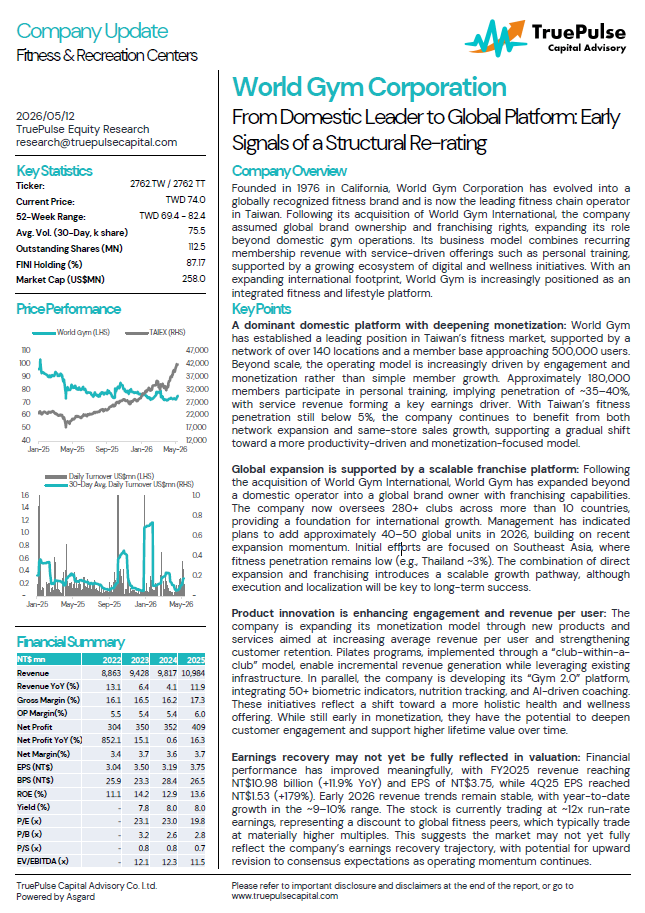
Earnings recovery may not yet be fully reflected in valuation: Financial performance has improved meaningfully, with FY2025 revenue reaching NT$10.98 billion (+11.9% YoY) and EPS of NT$3.75, while 4Q25 EPS reached NT$1.53 (+179%). Early 2026 revenue trends remain stable, with year-to-date growth in the ~9–10% range. The stock is currently trading at ~12x run-rate earnings, representing a discount to global fitness peers, which typically trade at materially higher multiples. This suggests the market may not yet fully reflect the company’s earnings recovery trajectory, with potential for upward revision to consensus expectations as operating momentum continues.