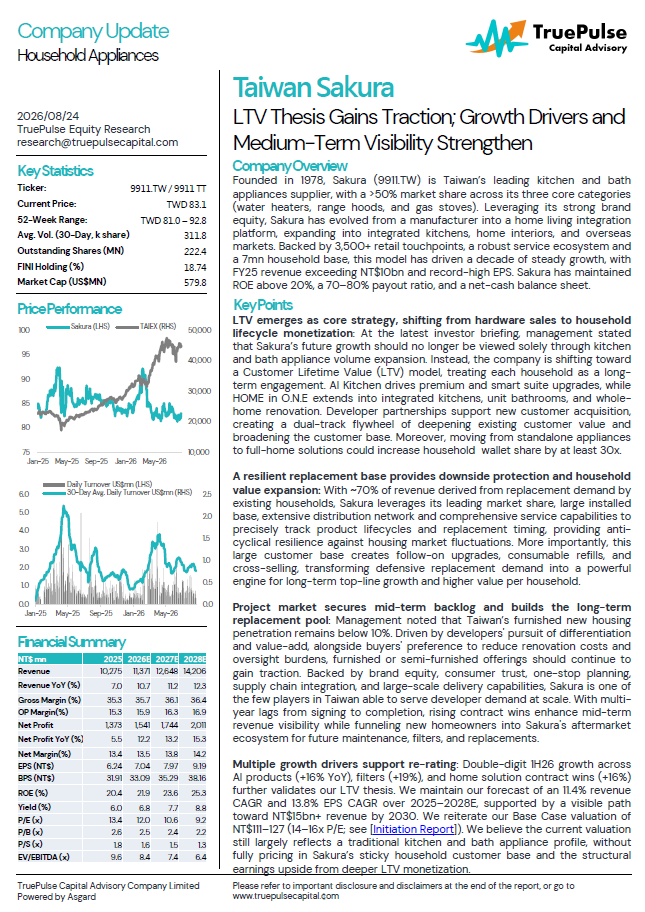

Taiwan Sakura (9911 TT): LTV Thesis Gains Traction; Growth Drivers and Medium-Term Visibility Strengthen
Company Overview
Founded in 1978, Sakura (9911.TW) is Taiwan’s leading kitchen and bath appliances supplier, with a >50% market share across its three core categories (water heaters, range hoods, and gas stoves). Leveraging its strong brand equity, Sakura has evolved from a manufacturer into a home living integration platform, expanding into integrated kitchens, home interiors, and overseas markets. Backed by 3,500+ retail touchpoints, a robust service ecosystem and a 7mn household base, this model has driven a decade of steady growth, with FY25 revenue exceeding NT$10bn and record-high EPS. Sakura has maintained ROE above 20%, a 70–80% payout ratio, and a net-cash balance sheet.
Key Points
LTV emerges as core strategy, shifting from hardware sales to household lifecycle monetization: At the latest investor briefing, management stated that Sakura’s future growth should no longer be viewed solely through kitchen and bath appliance volume expansion. Instead, the company is shifting toward a Customer Lifetime Value (LTV) model, treating each household as a long-term engagement. AI Kitchen drives premium and smart suite upgrades, while HOME in O.N.E extends into integrated kitchens, unit bathrooms, and whole-home renovation. Developer partnerships support new customer acquisition, creating a dual-track flywheel of deepening existing customer value and broadening the customer base. Moreover, moving from standalone appliances to full-home solutions could increase household wallet share by at least 30x.
A resilient replacement base provides downside protection and household value expansion: With ~70% of revenue derived from replacement demand by existing households, Sakura leverages its leading market share, large installed base, extensive distribution network and comprehensive service capabilities to precisely track product lifecycles and replacement timing, providing anti-cyclical resilience against housing market fluctuations. More importantly, this large customer base creates follow-on upgrades, consumable refills, and cross-selling, transforming defensive replacement demand into a powerful engine for long-term top-line growth and higher value per household.
Project market secures mid-term backlog and builds the long-term replacement pool: Management noted that Taiwan’s furnished new housing penetration remains below 10%. Driven by developers’ pursuit of differentiation and value-add, alongside buyers’ preference to reduce renovation costs and oversight burdens, furnished or semi-furnished offerings should continue to gain traction. Backed by brand equity, consumer trust, one-stop planning, supply chain integration, and large-scale delivery capabilities, Sakura is one of the few players in Taiwan able to serve developer demand at scale. With multi-year lags from signing to completion, rising contract wins enhance mid-term revenue visibility while funneling new homeowners into Sakura’s aftermarket ecosystem for future maintenance, filters, and replacements.
Multiple growth drivers support re-rating: Double-digit 1H26 growth across AI products (+16% YoY), filters (+19%), and home solution contract wins (+16%) further validates our LTV thesis. We maintain our forecast of an 11.4% revenue CAGR and 13.8% EPS CAGR over 2025–2028E, supported by a visible path toward NT$15bn+ revenue by 2030. We reiterate our Base Case valuation of NT$111–127 (14–16x P/E; see [Initiation Report]). We believe the current valuation still largely reflects a traditional kitchen and bath appliance profile, without fully pricing in Sakura’s sticky household customer base and the structural earnings upside from deeper LTV monetization.