
Succession and Renewal: The New Mandate for Taiwan’s Family-Owned Companies
— Insights from the 2025 Chinese Family Business Report × TruePulse Perspective
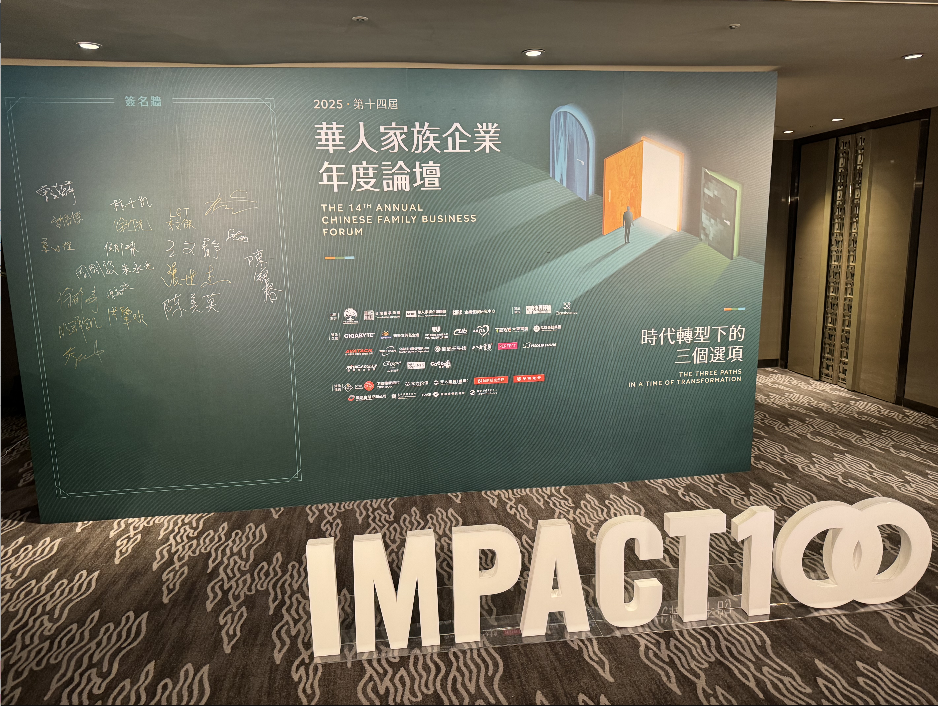
We were honored to be invited by the Taiwan Institute of Directors to attend the 14th Annual Chinese Family Business Forum. This year’s theme, “The Three Paths in a Time of Transformation,” addressed the structural challenges facing family-owned enterprises as they navigate succession, governance, and long-term competitiveness. The newly released 2025 Chinese Family Business Report sheds light on the profound shifts occurring among Taiwan’s family businesses—many of which align closely with what we observe when advising listed companies. Succession is no longer a private family issue; it has become a strategic matter tied to governance quality, ownership stability, corporate resilience, and market confidence.
Family-owned enterprises in Taiwan are at a critical inflection point. As many companies transition into the second and third generation, succession has evolved into a multifaceted challenge that touches governance, ownership concentration, innovation capacity, and investor trust. Global supply chain realignment, rapid advances in AI, and rising expectations from capital markets have further raised the bar. Against this backdrop, the Report highlights that the foundations supporting family businesses are shifting, and the quality of leadership transition and governance will shape whether companies can continue growing into the next decade.
Taiwan is one of the few markets where a meaningful portion of family businesses have entered later generational stages. This places companies at the intersection of two distinct forces: the relational and emotional dynamics of Chinese family culture, and the institutional expectations of global governance standards. From founder-led operations to the gradual differentiation between family governance and corporate governance, and eventually to stronger board independence, Taiwan’s family enterprises are now entering a stage where family leadership, board governance, and professional management must work in parallel.
The Report also highlights a concerning trend: while the number of family-owned listed companies has grown to 1,215, their overall competitiveness has declined. Their share of total market capitalization has fallen from 64 percent to 32 percent over the past decade, far behind the broader market. Inheritance rules have accelerated ownership fragmentation, reducing family control. High dividend payout ratios have constrained reinvestment, weakening innovation and diversification. Since 2023, family business stock performance has fallen below the market—a structural “crossing point” that historically is difficult to reverse. These shifts reflect a broader erosion of investor confidence in the growth potential of family enterprises.
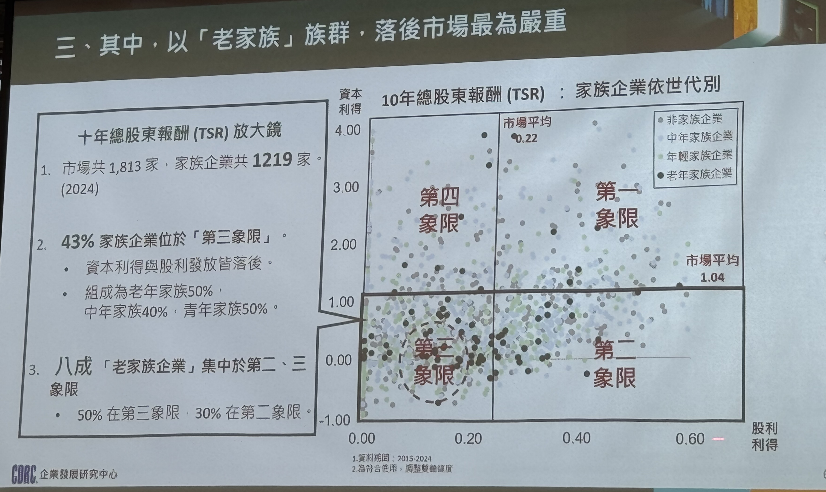
Performance analysis reinforces this divergence. More than 40 percent of family businesses fall into the quadrant of declining earnings and stagnant share prices, and half of them have over sixty years of history. In contrast, top-performing companies have grown profits more than fivefold and expanded market capitalization more than fourfold over the past decade. The gap is not defined by industry or company size but by governance maturity, leadership readiness, and the clarity and credibility of a company’s long-term vision.
The Report encourages a modern approach to succession. Rather than limiting the next generation to the binary decision of “take over or not,” it proposes broader roles through which successors can contribute—such as serving as responsible shareholders involved in governance, gaining operational or board experience, or leading strategic transformation in areas such as globalization, digitalization, or AI adoption. The most damaging scenario is not declining to take over; it is leaving the company unchanged and underprepared. To support more robust governance frameworks, the Taiwan Institute of Directors also introduced the concept of a “Taiwan-style family office,” which expands the notion of governance from wealth management to decision-making, voting structure, and generational role alignment.
From TruePulse’s perspective, the most critical challenges for family-owned listed companies ultimately converge on three areas: ownership, valuation, and communication. Ownership stability is essential as family stakes naturally fragment; increasing long-term institutional and foreign ownership can strengthen governance continuity and reduce vulnerability. Valuation serves as a strategic defense—companies with stronger narratives, clearer disclosure, and more consistent investor engagement tend to achieve higher valuation floors and greater investor confidence. Communication is equally important. Many family businesses underperform not because of operational weaknesses but because the market lacks a coherent understanding of their strategy, progress, and intentions. Transparent and consistent communication is particularly vital during periods of leadership transition.
Ultimately, the next decade for Taiwan’s family-owned listed companies will be defined by their ability to integrate governance discipline, ownership planning, and a compelling market narrative. Those that strengthen these pillars will be better positioned to regain market confidence and build sustainable long-term value. At TruePulse Capital Advisory, we look forward to supporting family enterprises navigating succession, ownership restructuring, and the need for more strategic investor communication, helping them shape the next chapter of their competitive journey.